
The short answer: KitchenAid shares the Whirlpool control platform, so its ovens post two-part F#-E# codes and its dishwashers report faults through flashing light patterns. Refrigerators are mostly symptom-diagnosed. Below is a map of the KitchenAid problems we see most in Brookville kitchens, which you can clear yourself, and which need a technician.
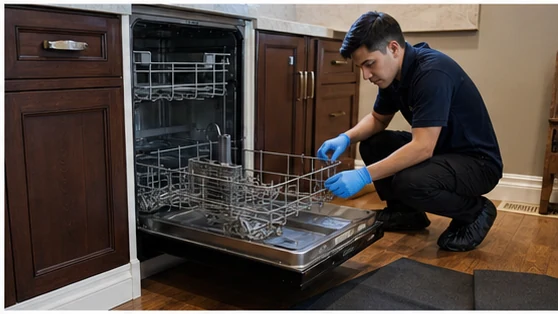
Kitchenaid Dishwasher Problems
Dishwashers are the KitchenAid appliance we service most. Rather than a numeric display, most KitchenAid dishwashers, including the KDTM, KDPM, and KDFE series, signal faults with a blinking clean light or a repeating flash pattern. The count of flashes maps to a specific fault, but the practical takeaway is that the two most common problems are drainage and heating.
| Symptom | Likely Cause | Fix |
|---|---|---|
| Water left standing in tub | Clogged filter, kinked drain hose, or drain pump fault | Clean filter, clear hose; replace pump if needed |
| Dishes wet, not drying | Failed heating element or vent fault | Test and replace heating element |
| Blinking clean light | Fault stored in control, often heat or drain | Read flash pattern, diagnose named circuit |
| Will not fill | Water inlet valve or float switch | Replace inlet valve; free stuck float |
Standing Water and Drainage
If the tub holds water at the end of a cycle, start with the filter in the base and the drain hose. A clogged filter is the single most common cause and an easy owner fix. Check that the hose is not kinked and the disposal or sink connection is clear. If the tub still will not drain, the drain pump or its wiring is the next suspect and needs service.
Poor Drying
KitchenAid dishwashers rely on a heating element for drying. When dishes come out wet, the element has often failed. This is a defined repair with a a part selected for the approved scope that restores proper drying without changing your cycle settings.
On KitchenAid dishwashers, a blocked filter is behind a large share of drain complaints and blinking-light faults. Pull the filter assembly in the base of the tub, rinse it under the tap, clear the sump beneath it, and run a short cycle. Doing this monthly prevents most drainage faults from ever appearing and can clear a fault that would otherwise look like a pump failure.
Kitchenaid Oven Fault Codes
KitchenAid wall ovens and ranges use the same F#-E# structure as Jenn-Air and Whirlpool. The F number names the fault, the E number the sub-fault. The codes below are the ones we see most across the KODE, KOSE, and KFGG lines.
| Code | System | What It Usually Means |
|---|---|---|
| F2-E1 | Keypad | Stuck touchpad button, sensed as a held key |
| F3-E0 / F3-E1 | Oven temp sensor | Open or shorted temperature sensor or its wiring |
| F1-E0 | Control board | Main control (EEPROM) fault |
| F5-E1 | Door lock | Latch or lock switch fault, common after self-clean |
As with any of these codes, a single power cycle at the breaker can clear a stray reading. If the same F#-E# returns, it is naming a failed part. F3 points to the temperature sensor, F2-E1 to the keypad, and F5 to the door latch, each a defined repair.
Refrigerator and Ice Maker Faults
KitchenAid refrigerators, including the built-in and French-door lines, most often need attention for ice production, cooling, and water dispensing. An overdue water filter is the most common and most overlooked cause behind weak ice and slow dispensing. Beyond that, a frozen fill tube, a failed inlet valve, or a worn ice-maker module accounts for most ice complaints.
When a KitchenAid refrigerator runs but will not cool, the usual causes are dirty condenser coils choking airflow, a failed evaporator or condenser fan, or a defrost system fault that lets the evaporator ice over. These need a technician to test the sealed system and the defrost circuit.
Maintenance That Prevents Kitchenaid Repairs
Rinse the Dishwasher Filter Monthly
A clean filter is the best defense against drainage faults and blinking-light codes. It takes two minutes and prevents the most common service call we get.
Change the Refrigerator Water Filter on Schedule
Most KitchenAid refrigerators want a new water filter every six months. An overdue filter chokes both the dispenser and the ice maker, which is often mistaken for a part failure.
Use Self-Clean Sparingly
The oven's self-clean cycle runs very hot and is the most common trigger for F5 latch faults. Use it rarely and let the oven cool completely before opening.
When to Call a Technician
Handle the filter cleaning, water-filter changes, and drain-path checks yourself. Call for service when a dishwasher will not drain after you clean the filter, when a blinking pattern returns, when an oven F3 or F5 code repeats, or when the refrigerator loses cooling. These repairs involve pumps, heating elements, sealed systems, and precision sensors that need proper testing. Every repair we perform carries our Written warranty terms for eligible completed repairs. Diagnostic and travel fees, if applicable, are confirmed before the appointment and before repair approval.
Frequently Asked Questions
What Does a Blinking or Flashing Light on a Kitchenaid Dishwasher Mean?
What Does an F2-E1 Code Mean on a Kitchenaid Oven?
Why Is My Kitchenaid Refrigerator Not Making Ice?
Related
Kitchenaid Repair
Dishwashers, refrigerators, and ovens serviced across Brookville and Nassau County.
View brand → GuideJenn-Air Repair Guide
Fault codes and fixes for Jenn-Air, which shares the same control platform.
Read more → ServiceDishwasher Repair
Drain, heat, and fill diagnosis and repair for built-in dishwashers.
View service →