
The short answer: True Residential wine columns are built to hold a tight temperature, so a real drift usually traces to one of four things: a door gasket that no longer seals, a temperature sensor giving the control a false reading, a stalled circulation fan leaving warm and cold pockets, or a dual-zone fault where one zone chases the wrong target. A degree or two of movement is normal. A persistent swing of five degrees or more is a fault worth diagnosing before it stresses the wine.
First, Separate Drift from Loading
Before treating drift as a failure, rule out how the column is used. A wine column full to the last slot, opened several times an evening during a Brookville dinner party, will read unstable simply because warm room air keeps entering and there is little room for air to circulate. Give the unit a day of normal, light use and watch the display. If it settles and holds, the column is healthy and the readings were tracking real disturbances. If it wanders on its own with the door shut and the racks reasonably loaded, then you are looking at a model-specific fault and the symptoms below will point you to it.
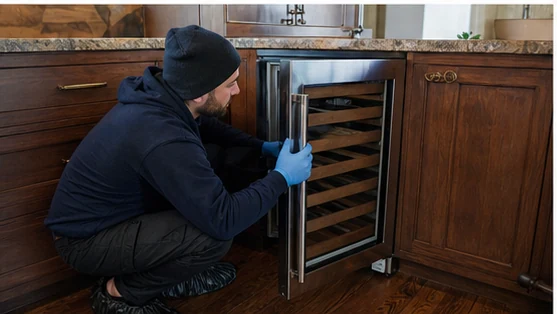
Symptoms and What They Point To
| Symptom | Likely Cause | What Is Happening |
|---|---|---|
| Slow warming, condensation near the door edge | Door gasket | A worn or dirty seal lets warm room air leak in and pull the cabinet off target |
| Display reads correct but bottles feel warm or cold | Temperature sensor | A drifting sensor feeds the control a false reading, so it stops cooling too early or too late |
| Warm at the top, cold at the bottom, uneven shelves | Circulation fan | A stalled interior fan stops mixing the air, creating temperature layers in the cabinet |
| One zone off target while the other holds fine | Dual-zone control | A failed damper, sensor, or board leaves one zone chasing the wrong temperature |
| Constant running, cabinet drifts warm anyway | Condenser or sealed system | A dusty condenser or refrigerant loss leaves the compressor working without holding temperature |
The Owner-Fixable Cause: Door Seal and Loading
The gasket is the first thing to check because it fails quietly. Over years, the flexible seal around the door hardens, collects grime, or takes a set from being pressed shut, and it stops making even contact all the way around. A simple test: close the door on a slip of paper and try to pull it out. If it slides free easily at any point along the edge, the seal is leaking there. Clean the gasket with warm soapy water so it flexes again, and if a section stays loose or cracked it should be replaced. Pair that with sensible loading, leaving a little air space, and many mild drifts resolve on their own.
The Sensor and Fan Causes
When the display shows the right number but the bottles tell a different story, suspect the temperature sensor. It is the control board's only window into the cabinet, and as it ages it can read a few degrees off, so the board cools to the wrong point. The symptom is a unit that seems confident on the display but wrong in the glass. A circulation fan fault looks different: the numbers are honest, but the cabinet stratifies, warm near the top and cold near the bottom, because nothing is mixing the air. Both the sensor and the fan motor are parts a technician tests and swaps; neither is a reliable owner repair.
The Dual-Zone Cause
If your True Residential column runs two zones, one for whites and one for reds, drift can be confined to a single zone. That points at the components that split the cabinet: a damper that regulates airflow between zones, a second sensor, or the control logic managing both. The tell is one zone holding perfectly while the other refuses to settle. Because the two zones share a cooling system but are controlled separately, isolating which part has failed takes proper diagnosis rather than guesswork.
Before you decide the column has failed, put an independent thermometer inside next to the shelf you care about and compare it to the display over a full day. If the two agree and both drift, the cooling side is the issue. If the display looks steady while the separate thermometer wanders, the sensor is likely lying to the control. That single comparison saves a lot of guessing and gives a technician a precise starting point.
What a Technician Checks
Diagnosis follows the symptom. For a suspected seal, the door alignment and gasket contact are checked all the way around. For a sensor complaint, the technician measures the sensor's resistance against temperature to see whether it is reading true. For stratification, the circulation fan motor is tested for voltage and continuity. For a single-zone dual-zone fault, the damper, second sensor, and control are isolated in turn. When the whole cabinet drifts under constant running, the condenser and sealed system are checked, with any refrigerant work handled under EPA certification. Parts needs and availability are confirmed after model-specific diagnosis. You can see the wider scope of what we service on our wine cooler repair page.
When to Call a Technician
Clean and test the door gasket, ease off on loading, and confirm the drift with a second thermometer first. Call for service when the seal is clean and even but the cabinet still drifts, when the display and an independent thermometer disagree, when the shelves show a clear warm-to-cold layering, or when one zone of a dual-zone column will not hold. Sensor, fan, damper, and sealed-system work all need proper testing. Completed repairs include a 180-day repair warranty. Written terms are provided with the repair.
Frequently Asked Questions
Why Does My True Residential Wine Column Keep Drifting Off Its Set Temperature?
What Temperature Should a True Residential Wine Column Be Set To?
Can I Fix Wine Column Temperature Drift Myself?
Related
True Residential Repair
True Residential wine columns, refrigeration, and undercounter units serviced across Brookville.
View brand → ServiceWine Cooler Repair
Gaskets, sensors, fans, and dual-zone controls diagnosed for luxury wine storage.
View service → ProblemTemperature Fluctuation
Why luxury refrigeration swings off its set point and how a technician traces it.
Read more →